
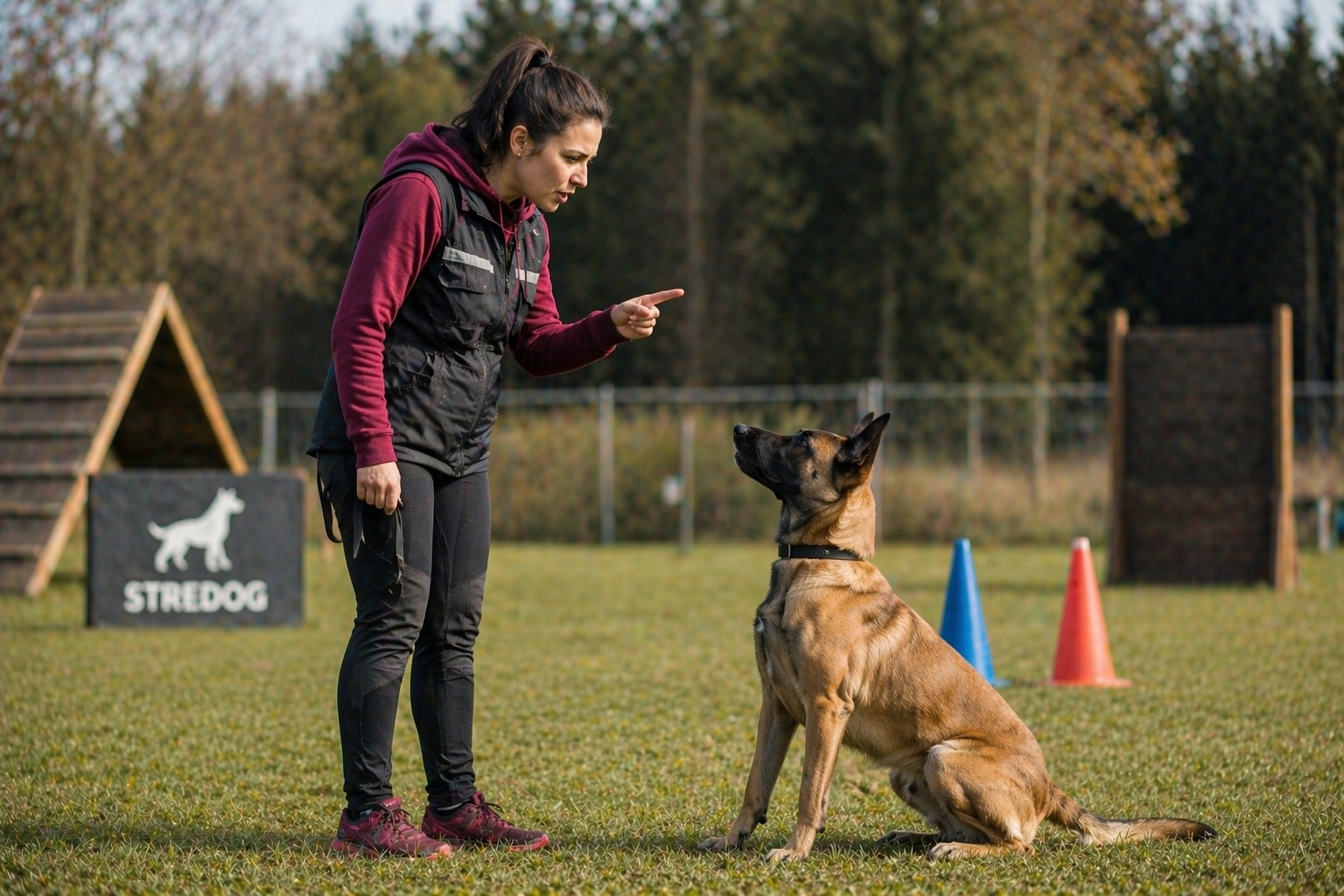
The Inconsistent Handler: How It Affects Results is one of those topics that is often underestimated, yet it has a direct impact on the quality of work—far more than most people realize. When something isn’t working, the natural tendency is to look at the dog, analyze the exercise, and search for errors in execution. In reality, in most cases, the critical point is not what the dog does, but what it receives. The dog is the final outcome of a communication system, and if that system is not stable, behavior cannot be stable either.
Inconsistency is not only about changing methods over time; it is something much more subtle and present in everyday work. It can be a cue given with a slightly different tone, a request made with misaligned energy, timing that shifts by just a fraction, or a rule applied inconsistently. These are minimal variations, often invisible to the handler, but extremely clear to the dog. Because the dog does not interpret intentions—it responds to what it perceives. And if perception changes, so does the response.
Dogs need stable references to work smoothly. They rely on associations, repetition, and clarity. When communication is consistent, behavior strengthens, becoming faster, more precise, and more reliable. When communication is variable, the dog cannot build a stable connection between what is asked and what is expected. This is not about ability or willingness—it is about understanding. If the signal is not always the same, the response cannot become solid.
One of the most evident effects of inconsistency is a loss of fluidity. The dog begins to slow down, introduce micro-pauses, and seek visual or contextual confirmation before acting. Where there was once an immediate response, hesitation appears. This is a very clear signal: the dog is no longer confident. It is not resisting or ignoring—it is trying to understand which version of the cue is correct in that moment.
Another common effect is instability in behavior. The same exercise may work perfectly in one session and fall apart in the next, even though nothing seems to have changed. In reality, something has changed—it lies in how the request was delivered. A shift in timing, energy, or posture from the handler is enough to alter the dog’s perception. This creates the feeling of inconsistent performance, often attributed to the dog, but rooted in communication.
When inconsistency persists over time, the dog develops alternative strategies to cope. One of the most common is anticipation. Lacking stability in the signal, the dog begins to rely on more predictable elements: the sequence of exercises, the context, or the handler’s habits. It anticipates to reduce uncertainty. But this inevitably leads to errors, mistimed responses, and a loss of true control over the work. The dog is no longer listening—it is guessing.
There is also a direct impact on the relationship. A dog working in an inconsistent environment gradually reduces its willingness to engage. Not because it “doesn’t want to work,” but because the work becomes harder to read. If every request may change, if every response may be right or wrong depending on the moment, the dog enters a state of uncertainty. Over time, uncertainty reduces motivation, initiative, and the quality of interaction.
In Mondioring, this aspect becomes even more evident. The dog is already managing a complex environment, with significant external variables: decoys, audience, stimuli, pressure. In this context, the handler must be the most stable reference point. If that reference also becomes inconsistent, the load on the dog increases dramatically. It is not only executing—it is interpreting. And this inevitably lowers the quality of performance.
The same dynamic exists in everyday life. A dog receiving inconsistent signals becomes less predictable, more reactive, and more likely to test boundaries. Without a clear system to rely on, it experiments, adapts, and responds inconsistently. On the other hand, a dog working within a consistent framework develops greater stability, confidence, and a clearer relationship with its handler. Not because less is required, but because everything is clearer.
Consistency does not mean rigidity or mechanical repetition. It means clarity. Signals must be recognizable, timing precise, and rules applied consistently. The dog should be able to read the work without constantly interpreting variations. This does not limit progress—on the contrary, it accelerates it, because it allows behavior to truly consolidate.
Timing is one of the most delicate elements. Even a correct signal, if delivered at the wrong moment, loses effectiveness. The dog associates what happens with what it perceives at that exact instant. If timing is inconsistent, learning becomes inconsistent as well. It is a technical detail with a significant impact on the final result.
Rule management is equally important. If a behavior is required, it must always be required. If it is not important, it should never be. Grey areas create ambiguity, and ambiguity creates instability. Dogs need clear boundaries to move confidently within the work.
The good news is that consistency can be trained. It is not an innate trait, but a skill developed through awareness and attention. It requires observation, the ability to question oneself, and a willingness to work on details. And often, it is precisely the details that make the difference.
When the handler becomes more consistent, the change in the dog is immediate. Responses become faster, cleaner, and more stable. The relationship strengthens, and the work becomes more fluid and less effortful. Not because the dog has suddenly improved, but because it has finally received a clear system to build upon.
In the end, the point is not to ask more from the dog, but to give better. Because what we see in the result is nothing more than the reflection of what the dog receives every day.