
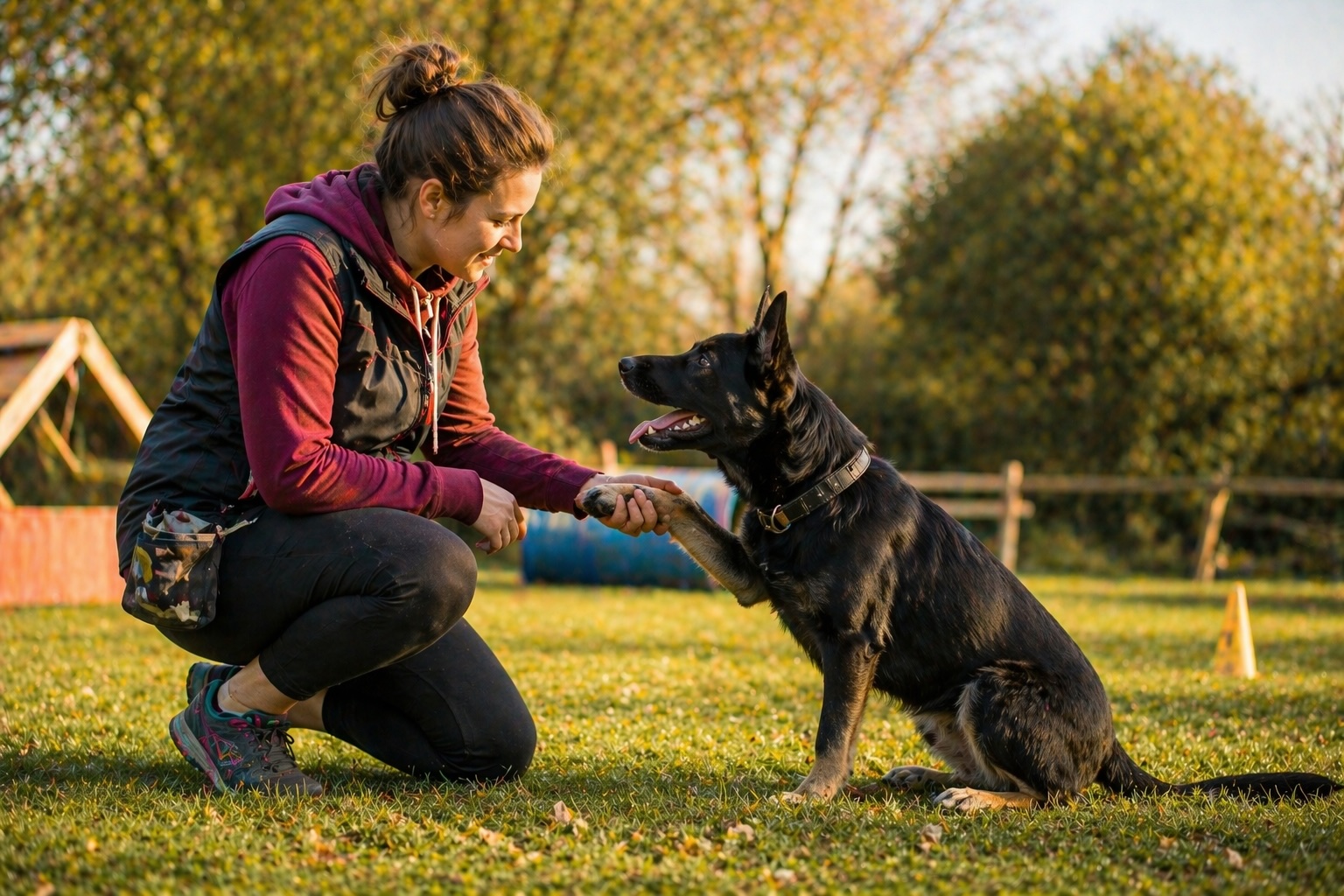
Trust in the dog: what it really means in training is one of those concepts that gets used often, but rarely explored in depth. Trust is often described as something intuitive, almost emotional, but in working with a dog it takes on a much more concrete meaning. It’s not just about “believing in the dog,” but about creating the conditions that allow the dog to be reliable even when the context changes.
Trust doesn’t come from a single successful moment, but from a history of consistent experiences. A dog doesn’t become reliable because it performed an exercise well once, but because it has shown over time that it can maintain that performance in different situations. It’s a process built day after day, through repetitions, variations, managed mistakes, and reinforced successes. This is where trust stops being a feeling and becomes a result of the work.
One of the most common misunderstandings is confusing trust with hope. Hoping the dog will perform is very different from knowing it will. When there isn’t a solid foundation, the handler tends to “try,” giving commands with a trace of doubt. And the dog perceives this state. Communication loses clarity, behavior becomes less stable. Trust, on the other hand, is recognized precisely by the absence of hesitation. The command is clear, and the dog responds without the need for adjustments.
But trust isn’t one-sided. It’s not only about what the handler feels toward the dog, but also the opposite. A dog that trusts its handler works differently. It is more willing, more stable, less reactive to changes. It understands that requests make sense, that the work is consistent, and that it won’t be put in a difficult situation without a way out. This sense of security completely changes the quality of the work.
In practical terms, trust becomes visible in moments when things aren’t perfect. When the context changes, when a distraction appears, when pressure increases. A dog without trust may hesitate, look for alternatives, lose structure. A dog with trust tends to stay within the work, even with some imperfections. It doesn’t abandon the task; it tries to remain engaged.
Another key element is error management. Trust is built there as well. If every mistake becomes a source of tension or confusion, the dog starts working cautiously, reducing initiative. If instead the mistake is treated as part of the process and handled clearly, the dog maintains openness and willingness. This doesn’t mean lowering standards, but creating an environment where the dog can work without fear of making mistakes.
In Mondioring, trust is a decisive factor. The dog often faces new situations, different decoys, changing dynamics, and high levels of pressure. It cannot rely on routine; it must rely on the work that has been built and on the relationship with the handler. In those moments, trust becomes operational. It’s no longer an abstract concept, but what holds the work together.
But even outside the discipline, in everyday life, trust changes everything. A dog that trusts is more manageable, more predictable, more relaxed. Not because it “obeys more,” but because it has a stable reference. This reduces reactive behaviors, improves the quality of the relationship, and makes the work more fluid.
Building trust requires consistency. Requests must be clear, signals always recognizable, rules stable. It doesn’t mean rigidity, but coherence. The dog must be able to read the work without ambiguity. Every inconsistency slows the process; every moment of clarity accelerates it.
It also requires time. There are no shortcuts. Trust cannot be forced or simulated. It is built through daily work, through experiences that accumulate and strengthen over time. And it is precisely this slow construction that makes it solid.
In the end, trust in the dog means knowing what to expect, even when the context changes. It means working without having to control every detail, because what has been built holds. It means having a dog that doesn’t perform only when everything is perfect, but that stays engaged even when it isn’t.
And that’s where the work becomes truly reliable.